Snowfroc (OWASP Denver)
Patterns of failure in modern authorization
· Denver, CO, USA
Modern authorization has grown from simple Unix file permissions into a maze of distributed systems across cloud providers and edge locations. This increasing complexity and scale has opened the door to new classes of security incidents. Looking at academic research and real-world incidents at companies like Meta, Microsoft, and Okta, we’ll dig into what went wrong and see how our fancy distributed architectures can create fun and exciting new ways for things to break.
The session will walk through practical approaches to securing token-based authorization, dealing with role explosion, and building solid testing strategies. You’ll come away understanding how authorization systems work and what it takes to build them securely—or at least with a healthy fear of policy management and the horrors it can wreak.
Context: About Me » Recovering system administrator » Secretly French ( ! don’t tell anybody) » Frequently ate lunch with the security folks at Datadog » Oh! I work at a start-up called Cerbos @phrawzty // cerbos.dev 2
Context: About Cerbos » “Externalized, policy-based, runtime authorization for your applications” » It’s literally a self-hosted binary with an HTTP API » There’s also a hub with a bunch of neat features @phrawzty // cerbos.dev 3
What is Authorization? » “Is this entity allowed to perform this action on this resource?” » Related to, but distinct from, authentication @phrawzty // cerbos.dev 4
Early Days: POSIX Permissions » User/Group/World model » Read/Write/Execute primitives @phrawzty // cerbos.dev 5
The Middle Ages: ACLs & RBAC » Access Control Lists » Role-Based Access Control frameworks @phrawzty // cerbos.dev 6
Modern Authorization » Token-based approaches (JWT, OIDC) » Federated systems » PBAC, ABAC, ReBAC… @phrawzty // cerbos.dev 7

When it all goes wrong (and it will) @phrawzty // cerbos.dev 8
Facebook “Privacy bug” Overview » ! May 2018 » Audience selector default changed to public » 14 million users affected » Policy enforcement failure during feature update @phrawzty // cerbos.dev 9
Facebook “Privacy bug” Key Authorization Failures » Default permission setting changed without user consent » Policy enforcement layer failed during UI update » Inadequate permission state validation @phrawzty // cerbos.dev 10
Okta “Support System breach” Overview » ! 2023 » HAR file exfiltration exposed session tokens » Auth bypasses in support systems @phrawzty // cerbos.dev 11
Okta “Support System breach” Key Authorization Failures » Overly permissive access to production » Insufficient isolation between support tiers » Authorization checks bypassed through session token theft » Inadequate token validation controls @phrawzty // cerbos.dev 12
Microsoft “Midnight Blizzard” Overview » ! 2024 » Password spray attack led to tenant compromise » Legacy tenants, basic auth, and privilege escalation @phrawzty // cerbos.dev 13
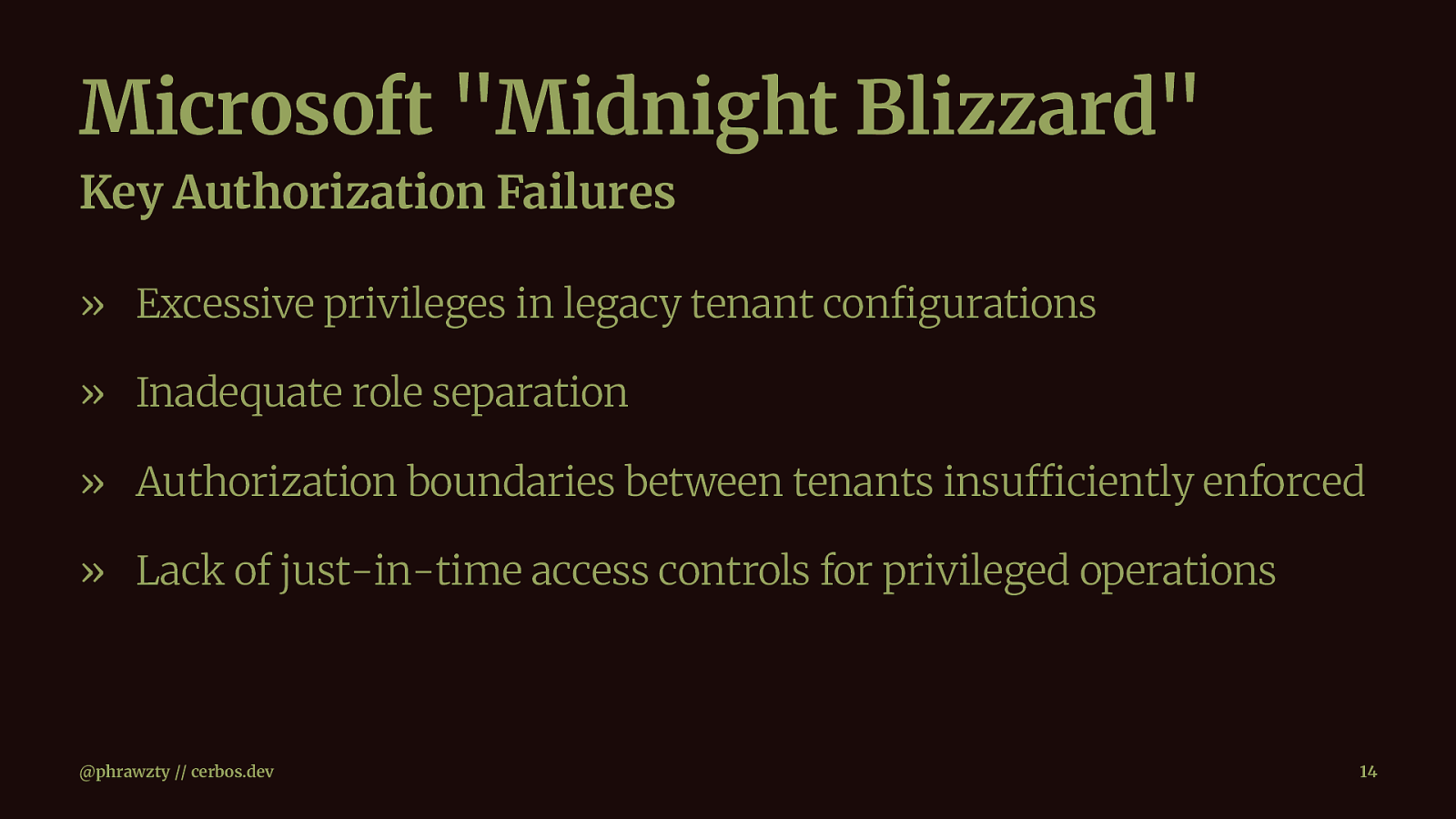
Microsoft “Midnight Blizzard” Key Authorization Failures » Excessive privileges in legacy tenant configurations » Inadequate role separation » Authorization boundaries between tenants insufficiently enforced » Lack of just-in-time access controls for privileged operations @phrawzty // cerbos.dev 14
How to stop it from all going wrong (or at least give yourself a fighting chance) @phrawzty // cerbos.dev 15
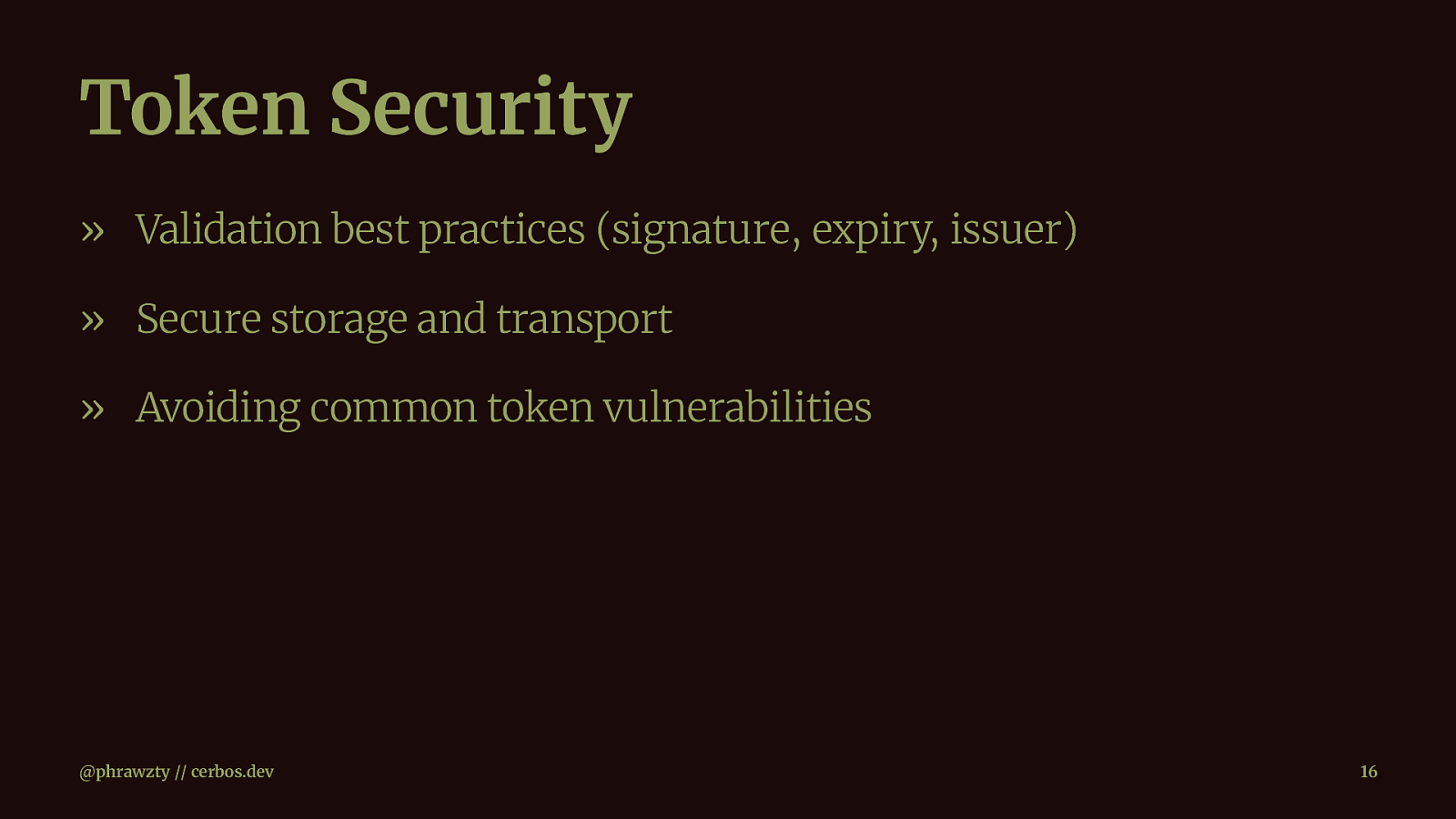
Token Security » Validation best practices (signature, expiry, issuer) » Secure storage and transport » Avoiding common token vulnerabilities @phrawzty // cerbos.dev 16
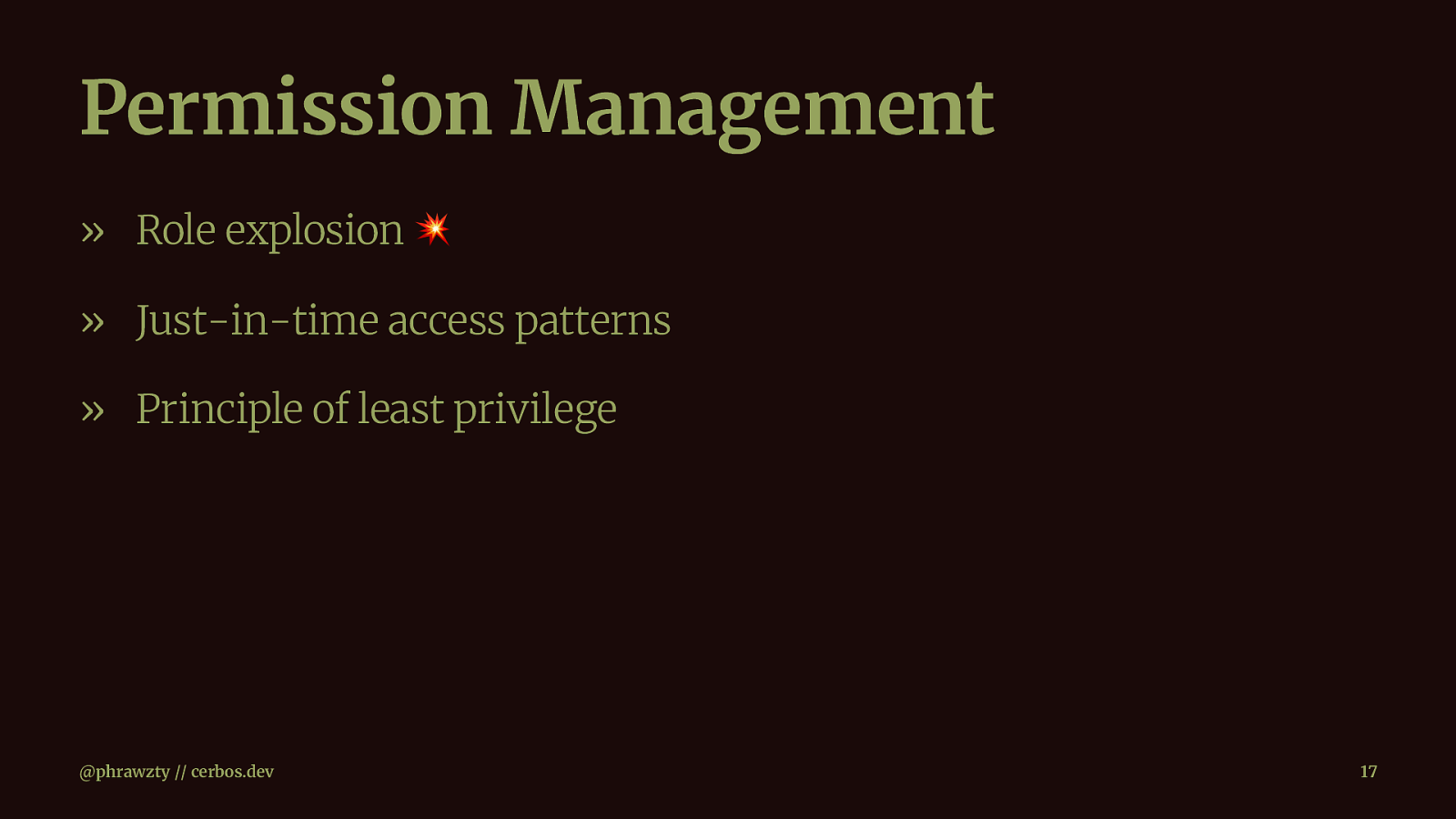
Permission Management » Role explosion ! » Just-in-time access patterns » Principle of least privilege @phrawzty // cerbos.dev 17
Externalizing Authorization » Clear separation between business logic and authz rules » Update policies without updating code » Enhanced auditability and compliance reporting @phrawzty // cerbos.dev 18
Testing Authorization Systems » Policy unit testing » Automated access review @phrawzty // cerbos.dev 19
Critical Path Patterns » High-availability authorization » Graceful degradation strategies » When in doubt, deny by default @phrawzty // cerbos.dev 20
Conclusion » Authorization fails at boundaries and transitions » Externalize your authorization decisions » Tokens require rigorous validation » Use just-in-time access and live the principle of least privilege » Test continuously and review access regularly @phrawzty // cerbos.dev 21

← play this game! (no really, it’s fun) 22