DevOpsDays Cairo 2024
Statements about Stateless
· Cairo, Cairo Governorate, Egypt
Stateless architecture is more than just functions as a service—it’s a powerful and interesting design choice that, like everything in the world of software development, comes with advantages and disadvantages. We’ll begin by examining the core principles of stateless design and how they contrast with traditional stateful approaches. The discussion will highlight key advantages, including improved scalability, easier deployment and maintenance, and enhanced fault tolerance. We’ll also address the trade-offs that come with statelessness, such as increased network traffic and complexity, potential performance issues—and the basic challenge of thinking about your software in a different way. Particular attention will be given to handling user sessions, caching mechanisms, and data consistency in a stateless environment. Attendees will gain insights into when and how to leverage statelessness, along with practical tips for overcoming common hurdles in stateless application management.
Statements Abou t Stateless DevOpsDays Cairo 2024 Dan “phrawzty” Maher
Dan “phrawzty” Maher ! Open Source Engineer @ Cerbos ! Co-Chair of DevOpsDays ! Previously Scaleway, Datadog, Mozilla, Ubisoft… ! A little more ops than dev ;) @phrawzty // cerbos.dev 2
Cerbos - Externalised, policy-based runtime authorisation for your applications. - Open source, written in Go - https://cerbos.dev/ - Most importantly: it’s stateless! @phrawzty // cerbos.dev 4
Agenda 1. Core Principles 2. Advantages & Disadvantages 3. Practical Concerns @phrawzty // cerbos.dev 5
Agenda 0. What Even Is State? 1. Core Principles 2. Advantages & Disadvantages 3. Practical Concerns @phrawzty // cerbos.dev 6
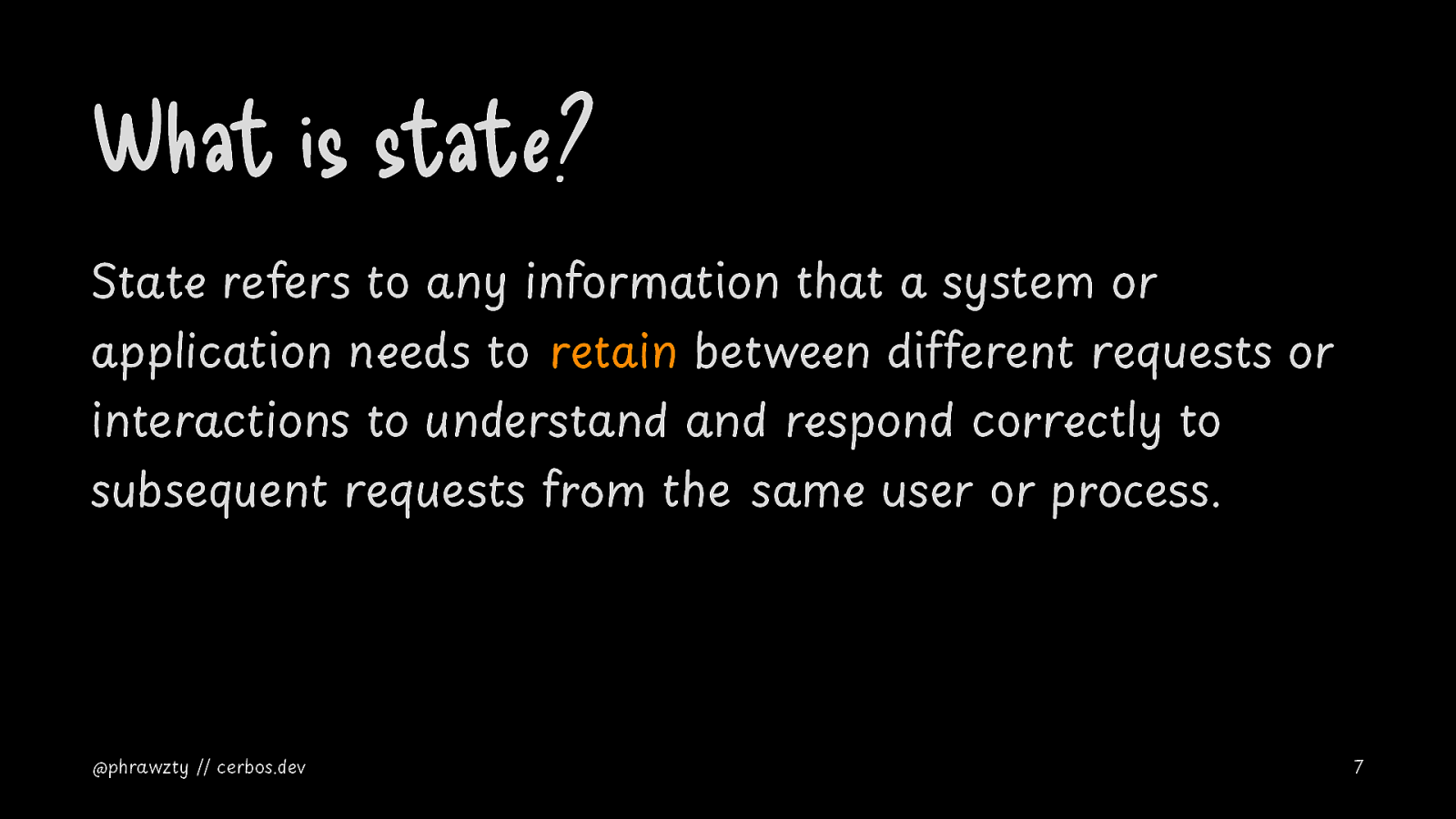
What is state? State refers to any information that a system or application needs to retain between different requests or interactions to understand and respond correctly to subsequent requests from the same user or process. @phrawzty // cerbos.dev 7
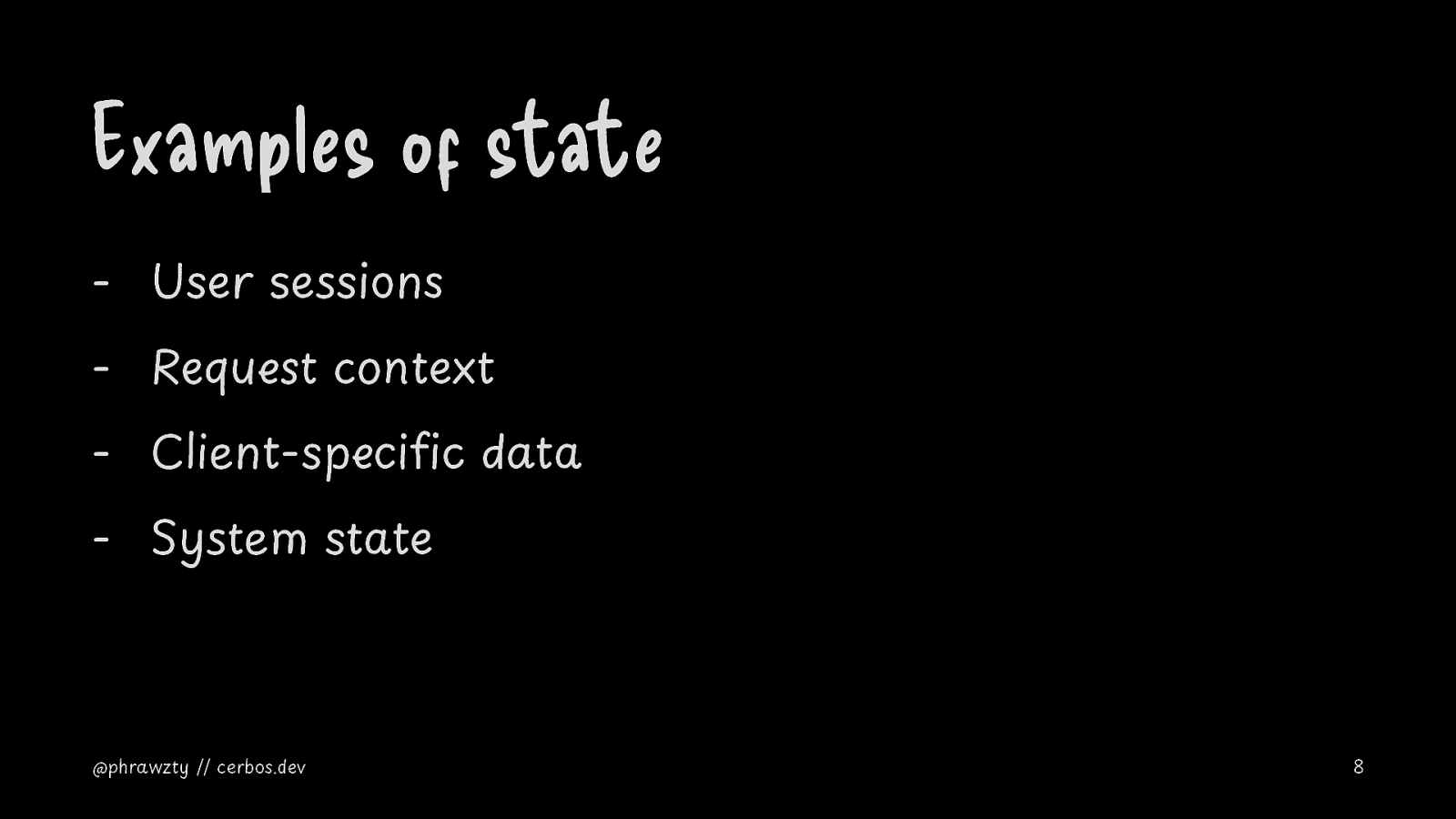
Examples of state - User sessions - Request context - Client-specific data - System state @phrawzty // cerbos.dev 8
Is stateless real? @phrawzty // cerbos.dev 9
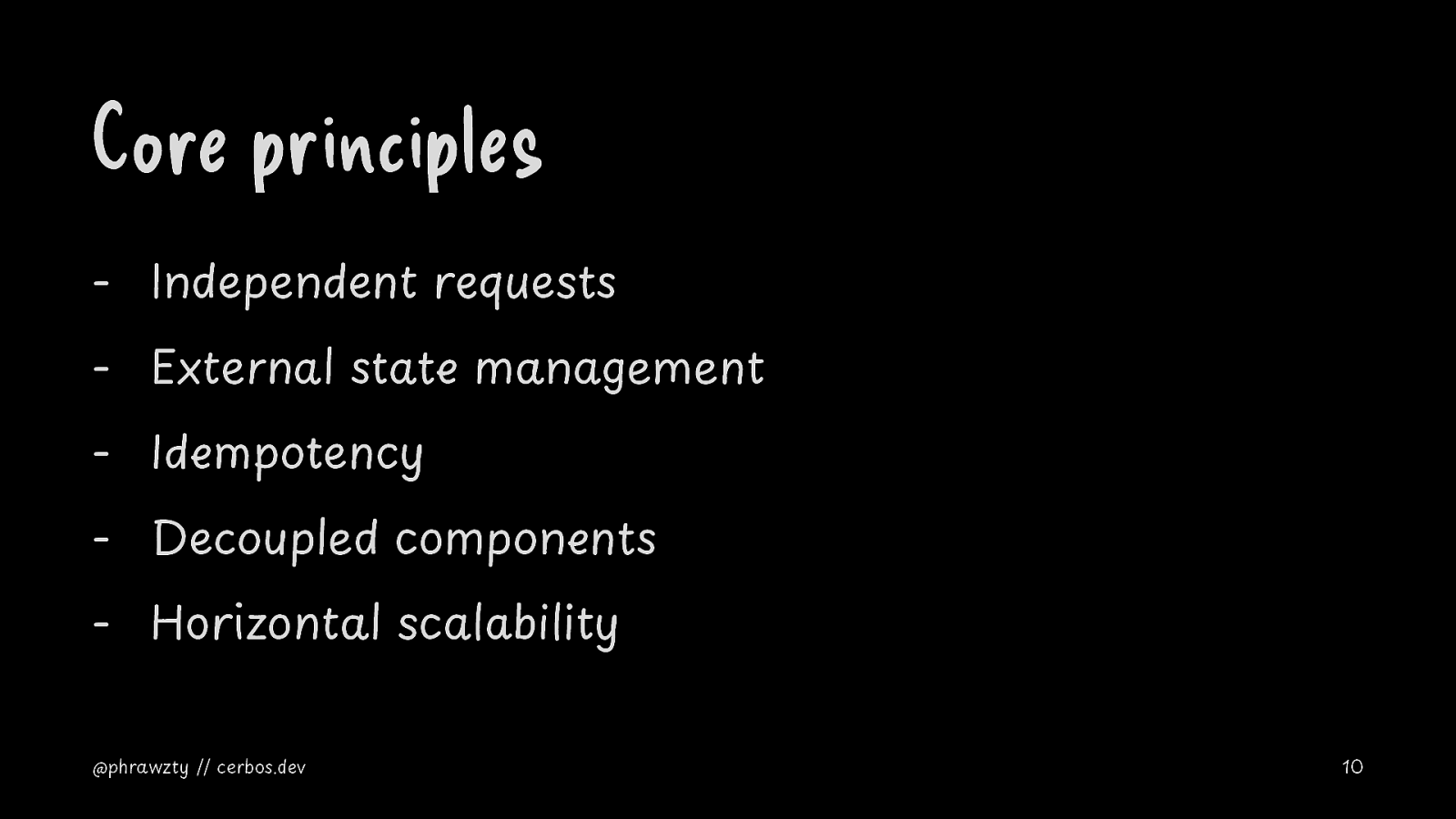
Core principles - Independent requests - External state management - Idempotency - Decoupled components - Horizontal scalability @phrawzty // cerbos.dev 10
Independent requests - Every request is self-contained - Every request is (considered) a fresh interaction @phrawzty // cerbos.dev 11
Ex ternal state management - State is managed outside of the interaction - Client or external system manages continuity @phrawzty // cerbos.dev 12
Idempotency - Same request, same result - “referential transparency” @phrawzty // cerbos.dev 13
Decoupled components - No shared state means forced modularity - Components communicate through interfaces @phrawzty // cerbos.dev 14
Horizontal scalabili ty - Distributed workload by nature - Cloud native (cloud-friendly?) @phrawzty // cerbos.dev 15
Advantages & Disadvantages - Independent requests - External state management - Idempotency - Decoupled components - Horizontal scalability @phrawzty // cerbos.dev 16
Independent requests - Advantages: Resilient, flexible, and distributed - Disadvantages: Increased overhead, high network dependence @phrawzty // cerbos.dev 17
Ex ternal state management - Advantages: Simplified server-side, straightforward scalability - Disadvantages: “Unusual” security profile, state synchronisation challenges @phrawzty // cerbos.dev 18
Idempotency - Advantages: Improved reliability, graceful error recovery - Disadvantages: Reduced flexibility, potentially complex implementation @phrawzty // cerbos.dev 19
Decoupled components - Advantages: Modular, flexible, fault-tolerant - Disadvantages: Coordination overhead, network intensive, sensitive to latency @phrawzty // cerbos.dev 20
Horizontal Scaling - Advantages: Elasticity, load distribution, resilience - Disadvantages: Now you’re managing a distributed system. My condolences. @phrawzty // cerbos.dev 21
Practical Concerns - Handling user sessions - Caching mechanisms - Deployment and lifecycle Image courtesy Bent Inge Johansen (public domain): https://flic.kr/p/tjuZMw @phrawzty // cerbos.dev 22
Handling user sessions - Externalised session management - Client tokens (e.g. JWT) @phrawzty // cerbos.dev 23
JSON Web Tokens (JWT) - Good: Stateless, compact, cryptographically secure signature - Bad: Difficult to revoke, plaintext paylod @phrawzty // cerbos.dev 24
Caching mechanisms - Distrbuted key/value store - HTTP caching at the edge - Browser cache @phrawzty // cerbos.dev 25
Test your caching mechanisms! - Load testing, misses, unexpected invalidations, consistency concerns… @phrawzty // cerbos.dev 26
Deployment and lifecycle concerns - Deployment / environment consistency - Dependencies and service discovery - Load balancing and traffic management @phrawzty // cerbos.dev 27
Deployment / environment consistency - Side effects and emergent properties - Situational differences @phrawzty // cerbos.dev 28
Dependencies and service discovery - State management - So many services! @phrawzty // cerbos.dev 29
Load balancing and traffic management - Balancing algorithms and affinity - (Auto) Scaling @phrawzty // cerbos.dev 30
Conclusion - Everything is a trade-off @phrawzty // cerbos.dev 31
Actually the conclusion @phrawzty // cerbos.dev 32